

By: Steve-
On: 30 Aug 2026


| Sub-Total : | $23.30 |
| Eco Tax (-2.00) : | $4.52 |
| VAT (20%) : | $5.66 |
| Total : | $33.48 |
By: Steve-
On: 30 Aug 2026
Several companies showcased their core products, including Dongguan-based Mars Project, which presented its flagship product, the "Xiao Pa AI" companion doll. (Photo by Huang Weixing)
On the afternoon of August 27th, the "Guangdong Goods Go Global" Autumn Action Chip Industry Production and Sales Matching City Alliance Smart Sensor Industry Chain Upstream and Downstream Supply and Demand Matching Event was held in Songshan Lake, Dongguan. Guided by the Guangdong Provincial Department of Industry and Information Technology, this event brought together over 80 upstream and downstream enterprises, terminal manufacturers, universities, research institutes, and investment institutions from Guangzhou, Shenzhen, Zhuhai, and Dongguan. Focusing on "supply and demand matching + scenario implementation," the event aimed to create a collaborative link for Guangdong's smart sensor industry.
Smart sensors are known as the "nerve endings" of the digital age and are core foundational components for industries such as AI, new energy vehicles, and robotics. Guangdong is a major hub for smart sensors in China, boasting a massive market. AI smartphones, AI glasses, smartwatches, and other smart terminals provide a vast array of application scenarios for smart sensors. This event specifically targeted bottlenecks in the industry chain, using a dual model of "supply and demand matching + exhibition and live streaming" to accurately match upstream and downstream resources and facilitate smooth industry circulation.
Precise Matching of Supply and Demand
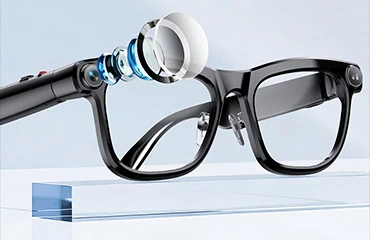
At the event, numerous companies showcased their core products. In the consumer electronics sector, vivo and OPPO exhibited their flagship models; companies such as Krite Cloud Technology, Guangna 4D, and Xingyi Intelligent presented multiple smart glasses models, covering diverse scenarios including AR navigation, real-time translation, activity tracking, and health monitoring; Mars Project's "Xiaopa AI" companion doll and Onbo Electronics' "Angju Xiaobao" elderly care robot respectively target the family companionship and elderly care markets, creating smart hardware that combines human warmth and practical value. In the core components sector, Moxian Technology's tactile data acquisition gloves and Zengxin Technology's wafers, among other self-developed products, broke through technological barriers, adapting to the needs of high-end manufacturing, automotive electronics, and other fields.
A relevant official from the Guangdong Provincial Department of Industry and Information Technology stated that Guangdong's chip industry foundation continues to solidify, its industrial ecosystem is becoming increasingly collaborative, and its development prospects are broad. During the 14th Five-Year Plan period, the province's semiconductor and integrated circuit industry cluster revenue is expected to grow at a compound annual growth rate of over 20%, with major integrated circuit projects investing over 500 billion yuan. This event is an important initiative for the four cities of Guangzhou, Shenzhen, Zhuhai, and Dongguan to jointly expand markets and promote collaboration, leveraging Guangdong's vast intelligent terminal market to drive mutual empowerment between the intelligent terminal and intelligent sensor industries.
As the host city, Dongguan is a significant hub for the sensor industry in the Guangdong-Hong Kong-Macao Greater Bay Area. The city currently has nearly 100 sensor companies, with an estimated output value of approximately 52 billion yuan in 2025; in the first half of 2026, the output value reached 25.5 billion yuan, a year-on-year increase of 14.4%, outpacing the city's average growth rate for large-scale industrial enterprises. In terms of industrial layout, Songshan Lake is focusing on high-end sectors to create an innovation hub, while towns and districts such as Liaobu and Chang'an are deeply cultivating niche markets, forming differentiated and collaborative industrial clusters.
The event adopts a dual-mode approach of "supply and demand matching + exhibition and live streaming." Downstream end-user companies collectively released their procurement and technology cooperation needs, while sensor companies conducted technology roadshows and showcased corresponding solutions. Simultaneously, on-site exhibitions and online live-streaming sales were launched, achieving a simultaneous increase in both publicity and sales momentum.
"This event brought tangible value to industry matchmaking. Upstream, it broadened procurement channels and optimized costs; downstream, it expanded cross-scenario customer resources," said Zheng Miaoling, Business Development Manager of Moxian Technology, a local company in Songshan Lake. The company focuses on the research and development of flexible pressure sensors, with products covering consumer electronics, healthcare, and robotics. "The company's revenue reached the tens of millions of yuan level in 2025, and this year we are moving towards the twenty million yuan target," Zheng Miaoling introduced. She added that in the future, the company will continue to tackle core technologies, promote "plug-and-play" products, and deeply integrate into the Guangdong intelligent terminal and robotics industry ecosystem.
Seizing the initiative through technological standards
Currently, the global electronics and information industry is in a new technological cycle characterized by the application of AI big data models on the edge and the explosive growth of wearable devices. However, it also faces the dual challenges of fluctuating global demand and supply chain restructuring. In this complex external environment, Guangdong, as my country's main consumer electronics manufacturing base, demonstrates its profound industrial resilience thanks to its vast industrial base and well-developed ecosystem.
The massive manufacturing capacity and export scale are Guangdong's most solid foundation for coping with external fluctuations. For example, in 2025, Guangdong's mobile phone production reached 652.0725 million units, accounting for 42.3% of the national total, and smartphone exports reached 191 million units, accounting for 33.6% of the national total; color TV production reached 116.0202 million units, and exports reached 77.7528 million units, both accounting for more than half of the national total.
In addition, computer production reached 88.8425 million units (accounting for 25.5% of the national total), wireless headphone exports reached 387 million units (accounting for 55.0% of the national total), and smartwatch and wristband exports reached 400 million units (accounting for 41.8% of the national total). The ability to cover all product categories and support massive deliveries is the most direct manifestation of its resilience against market risks.
Supporting this massive scale is a highly collaborative and differentiated regional industrial ecosystem. Currently, Guangdong has formed a pattern of "Shenzhen leading, Dongguan supporting, and Guangzhou and Zhuhai coordinating": Shenzhen, as the core hub of the entire industry chain, focuses on high-end manufacturing and brand integration; Dongguan, as a major center for complete machine manufacturing, ensures massive terminal shipments; Huizhou, relying on its electronic information industry foundation, focuses on developing color TVs and related OEM manufacturing; Guangzhou focuses on flexible displays and AI applications; and Zhuhai, taking smart glasses as a breakthrough, has a globally leading advantage in areas such as AR optical modules.
Faced with the new wave of AI and global technological competition, Guangdong's strategy lies in climbing upstream in the industry chain and seizing the right to speak through technical standards. The report "Top 100 Global 5G Standard Essential Patent Holders in 2025" shows that Guangdong accounts for more than 30% of the global 5G standard essential patents, with Huawei ranking first globally with a 15% share, and ZTE, OPPO, and vivo ranking 6th, 8th, and 10th globally, respectively. The increased influence in underlying technologies directly empowers terminal innovation, enabling major brands like Huawei to accelerate the implementation of large-scale models on mobile devices and launch new product forms such as HarmonyOS AI watches, gradually evolving from a mere manufacturing center to a technology source. Leveraging its massive production capacity, regional collaborative ecosystem, and continuous breakthroughs in 5G and AI technologies, Guangdong's consumer electronics industry is steadily moving towards the high-value end of the industry chain.
Source: Southern Daily
Please log in to your member account first. *




0 Comments