
By: Steve-
On: 29 Sep 2026





| Sub-Total : | $23.30 |
| Eco Tax (-2.00) : | $4.52 |
| VAT (20%) : | $5.66 |
| Total : | $33.48 |
By: Steve-
On: 29 Sep 2026
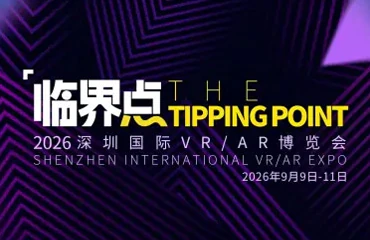
SIVA 2026 took place from September 9 to 11 at the Shenzhen World Exhibition & Convention Center. As AI glasses crossed the threshold for mass production and the XR industry shifted from mere technical demonstrations to commercial delivery, the theme "TIPPING POINT" was no longer just a slogan; it became a reality to be examined firsthand across the exhibition halls and forums.
The event was co-hosted by the China International Optoelectronic Exposition (CIOE) and the Shenzhen International VR/AR Expo (SIVA), with co-organization by Shenzhen Xieban Exhibition Co., Ltd., the Shenzhen Augmented Reality Technology Application Association, and Zhuijiao XR, and with support from WellsennXR. Leveraging the concurrent visitor traffic of CIOE, SIVA 2026 brought together over 100 high-quality exhibitors from across the industry chain and engaged more than 180,000 professional attendees from CIOE. Through a four-pronged synergy of "exhibition, conference, capital, and orders," the event facilitated technical exchanges, supply-demand matchmaking, and investment and financing collaborations.
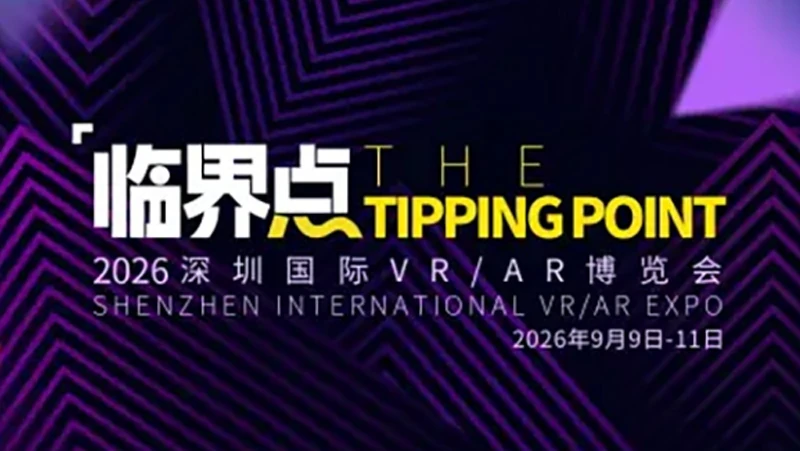
The event features four dedicated zones—VR/AR Optics, New VR/AR/AI Glasses, AI & AR Glasses/MR Device Supply Chain Teardowns, and AR/VR Innovative Applications—covering the entire industry chain from optics and micro-displays to finished devices and innovative use cases. On the exhibition floor, attendees simultaneously tested devices, compared specifications, and probed for supply chain details; meanwhile, the forums shifted the focus back to critical, practical issues: making devices lighter, ensuring display viability, enabling scalable content, and securing tangible orders.
The forums served as the most information-dense component of the three-day event. Key sessions—including the Global Spatial Computing Industry Development Forum, the AR/VR Optical Technology Application Summit, the AI/AR Glasses Industry Development Summit, and the Large-Scale Spatial Interaction and Immersive Experience Technology Summit—addressed four core themes: spatial computing, optics and micro-displays, mass production of AI glasses, and the commercialization of large-scale spatial applications.
Spatial Computing and Optics: Charting the Next Technological Frontier
The Global Spatial Computing Industry Development Forum was the first to pose questions regarding the industry's next phase of evolution. Centered on the theme of spatial computing, the forum brought together representatives from diverse sectors—including immersive entertainment, device brands, computing chips, spatial algorithms, world models, 3D AIGC, and Gaussian Splatting. Speakers included Anshanzi (Founder of Zhui Jiao XR), Zhang Hang (Senior Vice President at iQIYI), Zhang Lei (Head of Enterprise Software Products at PICO), Ren Pan (Co-founder and CEO of Pimax), Chen Yimin (Co-founder and Head of Chip R&D at Gravity), Lin Qiong (Founder of Xvisio), Li Yingli (Head of Ecosystem and Partnerships at VAST), Cheng Cheng (Deputy General Manager of CAS-Fusion Perception & Intelligence Research Institute), Liang Haohui (COO of Yingsu Technology), and Yu Hongzhi (Industry Director at Qiyu Innovation).
Over the past two years, advancements in headsets, lightweight glasses, and operating system platforms have moved in tandem, while developments in embodied AI, world models, and 3D content generation have expanded the industrial scope of spatial computing. Discussions have shifted beyond the headset form factor itself, branching out in three key directions: first, the emergence of "spatial intelligence"—driven by robotic perception and world models—which redefines XR from a mere display terminal into an environmental interface for intelligent agents; second, the reshaping of the application ecosystem through 3D content generation and the democratization of AI-driven creation, shifting the supply of spatial content from professional teams to individual creators; and third, the redefinition of on-device computing power driven by spatial computing chips and physical AI.
Drawing on these broad concepts, the speakers offered in-depth insights through specific lenses—such as delivering emotional value via commercial applications and empowering embodied AI with optical sensing technologies. As spatial computing came to be viewed as a new interface connecting digital content, the physical world, and intelligent agents, the atmosphere shifted from merely "observing trends" to "finding one's niche"; notably, far more attendees than in previous years stayed behind after the sessions to question the speakers about practical implementation pathways.
The AR/VR Optical Technology Application Summit refocused the discussion on hardware-related challenges. Bringing together key players from across the AR/VR optics supply chain, the forum featured presentations by eight distinguished speakers:
Edward Tang (CEO, Avegant); Wang Lichun (Division Director, Taimeike); Kong Yifan (R&D Director, Yibei Technology); Hu Dejiao (Optical Director, Nika Optics); Liu Yi (Deputy General Manager of New Market Development, Hongshi Intelligent); Jiang Zhenyu (Chairman, Qiushui Semiconductor); Chen Wencheng (Special Assistant to the Chairman, Crystal-Optech); and Liu Maofeng (Senior Engineer, Yingnuo Industrial).
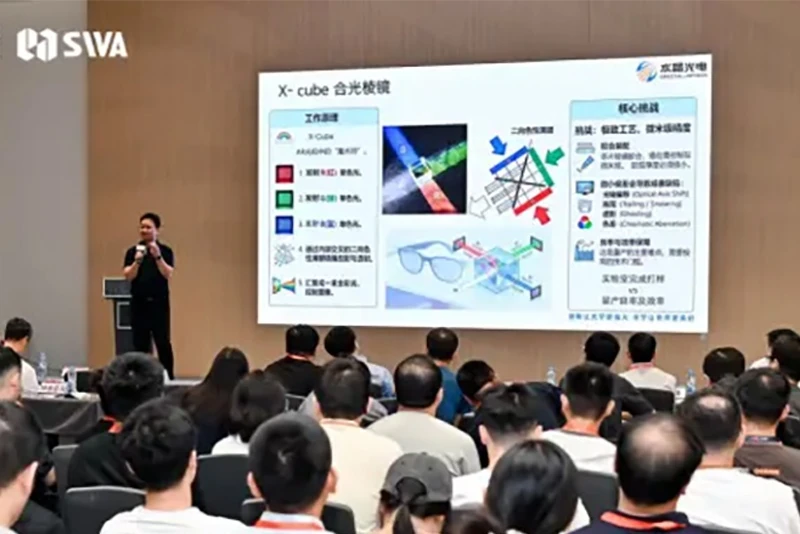
Lightness, brightness, yield rates, and the processes of inspection and manufacturing are the fundamental factors determining whether AR glasses can be worn in daily life. Discussions at the event progressed systematically along the "materials—optical engines—manufacturing" value chain: on one hand, there were engineering breakthroughs in display metrics such as full-color capabilities and lossless red-light performance; on the other, the industry tackled the practical challenges of mass-producing optical waveguides and controlling yields. Furthermore, the concept of a "New Moore's Law for AI Glasses"—introduced at the meeting—elevated the synergy between computing power and display technology from a mere matter of specifications to a driving force shaping the industry's pace of development.
These rigorous assessments from upstream players ensured the forum moved beyond mere conceptual promotion, breaking down the concept of "display usability" into verifiable technical processes. The persistent inquiries from supply chain companies and device manufacturers in the audience shifted the event's focus from the exhibition area back to the technology itself—underscoring the pivotal role of optics as the foundation of XR.
AI Glasses and Large-Scale Spatial Experiences: Advancing Mass Production and Operations in Tandem
The AI/AR Glasses Industry Development Summit on the second day shifted the spotlight to device manufacturing and the supply chain. The forum brought together 19 key figures from across the AI/AR glasses ecosystem, including Hiroshi Mukawa (Chief XR Strategy Officer, Sony Group), James Watkins (Myrias Optics), Hugo da Silva (CEO, Morphotonics), Joris Biskop (Founder & CEO, AddOptics), Jeong-hun Ha (CTO, LetinAR), Brian Kim (CEO, RAONTECH), Hans-Peter Mutzel (Commercial Operations Director, TriLite), Peter Wu (Sales Director for Asia, Tobii), Ma Guowen (General Manager of XR Product Line, Quectel), Shi Rui (Co-founder & CTO, Guangna Siwei), Li Shenggao (Senior Expert in Technology Planning, Highpower Technology), Xu Guojun (CTO, Luxshare Precision), Yin Chuanxue (Co-founder, INMO), Meng Xiangfeng (CEO, Zhige Technology), Yu Yangping (Partner & Senior VP, Guoyan Xinneng), Ru Yi (Founder & CEO, Liweike Technology), Dr. Sprengard (Senior VP & Global Head of AR Business, SCHOTT), JI Fischer (3D-Micromac), and Lu Weicheng (VP, 7invensun). Drawing on their respective areas of expertise, the speakers dissected the current state of the AI glasses industry across multiple dimensions, including device manufacturing, optics, displays, batteries, interaction, materials, and production processes.
As global shipments of AI glasses rapidly scale up, the industry has begun to map out commercialization pathways with an eye on the critical threshold of ten-million-unit shipments. There is a strong consensus on one key point: growth hinges not on a single product launch, but on the simultaneous viability of display technology, battery performance, weight, connectivity, algorithms, distribution channels, and services.
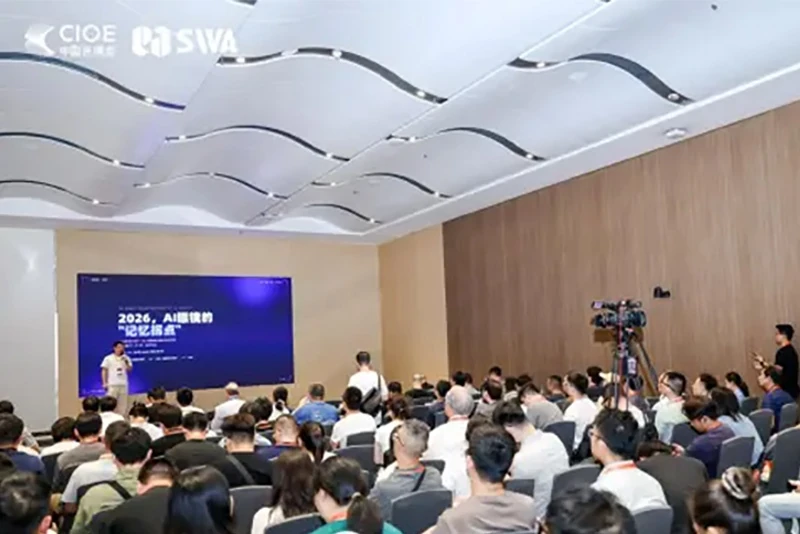
From mass-production constraints regarding display-grade optics and the foundation of full-stack manufacturing capabilities to the production ramp-up curves for reflective optical waveguides, the speaker addressed virtually every critical variable involved in the mass production of AI glasses. These discussions—spanning international markets and the entire industry value chain—transformed the concept of the "ten-million-unit threshold" from a mere slogan into a concrete checklist for supply chain verification; consequently, the buyers and engineers in the audience shifted the focus of their inquiries from "what new features are there?" to "when can stable delivery be guaranteed?"
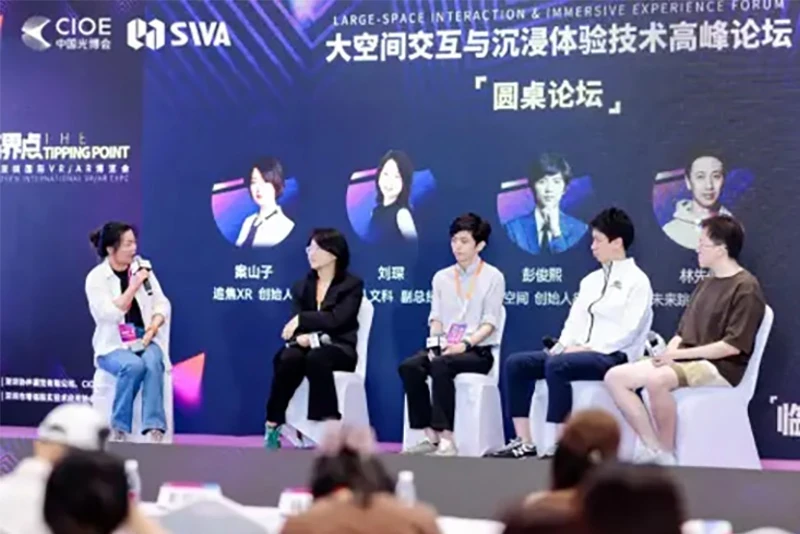
The third day’s summit on large-scale spatial interaction and immersive experience technologies focused on transforming content into a scalable business. The event brought together key figures at the forefront of large-scale spatial content creation and operations; five speakers delivered keynote presentations and engaged in an in-depth roundtable discussion. Participants included Liu Chen (Deputy General Manager, 798 Culture & Technology), Peng Junxi (Founder & CEO, Weixing Space), Lin Xianjian (General Manager, Future Tiaodong), Zhuang Zhiyong (General Manager, Chaoyuanli), and Wu Guanbao (Co-founder, Chaopaidui). While the viability of large-scale spatial VR has been repeatedly proven across sectors ranging from cultural tourism and sports to gaming, the scale of the business is determined not by the buzz surrounding individual projects, but by consistency across content production, venue deployment, operational workflows, and user retention.
The prevailing industry perspective has clearly shifted from a focus on "immersive spectacles" to "long-term operations." Key topics of discussion included how major intellectual properties (IPs) can sustain offline vitality, how to achieve standardized replication for sports-based and metaverse-integrated cultural tourism, and how large-scale VR games can successfully commercialize—with frontline operators presenting real-world data. A roundtable session titled "The Turning Point for Standardized Large-Scale VR" further advanced the conversation from experiential innovation to metrics such as sales per square meter, repeat patronage, and operational safety.
Only when content providers began openly crunching the numbers on "repeat purchase rates" did the "large-scale spatial experience" sector truly transition from mere exhibition and performance into a genuine business—indeed, the liveliest activity at the venue centered on partners connecting their venues and IP assets.
In addition to the four forums, there were two closed-door sessions: an investment and financing matchmaking meeting for new VR/AR technologies, and a seminar on AI glasses and intelligent agent applications.
The closed-door investment and financing matchmaking session on September 9 featured six roadshow projects covering MEMS laser scanning displays, South Korean hybrid reflective optics, US nanoimprint waveguide materials, Dutch roll-to-plate nanoimprinting, US LCoS light engines, and a Tsinghua-affiliated AI eyewear team. The closed-door seminar on AI eyewear and agent applications held on September 10 was an invitation-only event. Unlike public forums that prioritize breadth, these closed-door sessions focused on matching supply with demand and seeking answers to specific challenges: technical teams outlined their roadmaps, while investors and application partners probed for details on mass production, costs, and real-world deployment scenarios.
At the closed-door session on AI eyewear and agents, over 30 industry representatives engaged in in-depth discussions on topics such as the development of core underlying technologies (optics, displays, and chips) for AI AR glasses; the trade-offs between form factors and all-day wearability; and the opportunities for "hit" products versus privacy concerns associated with proactive AI. The atmosphere was vibrant, fostering a dynamic exchange of ideas.
Awards, New Products, and Capital: Commercial Coordinates Beyond the Tipping Point
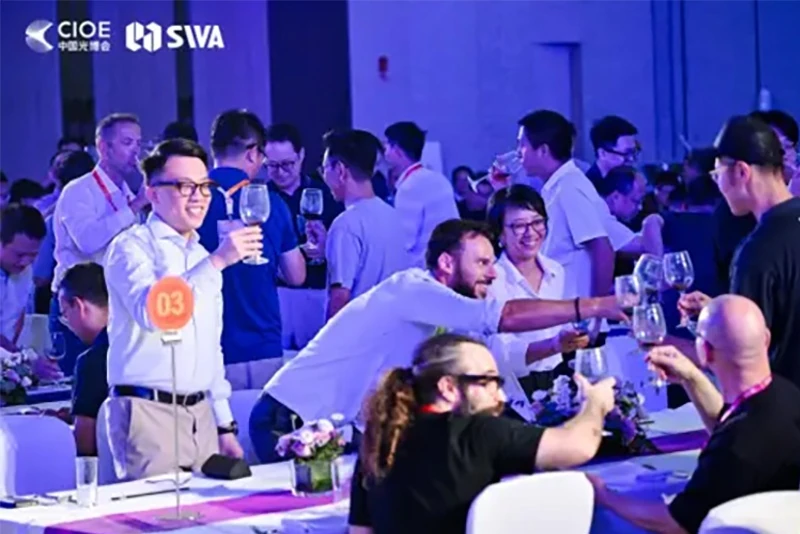
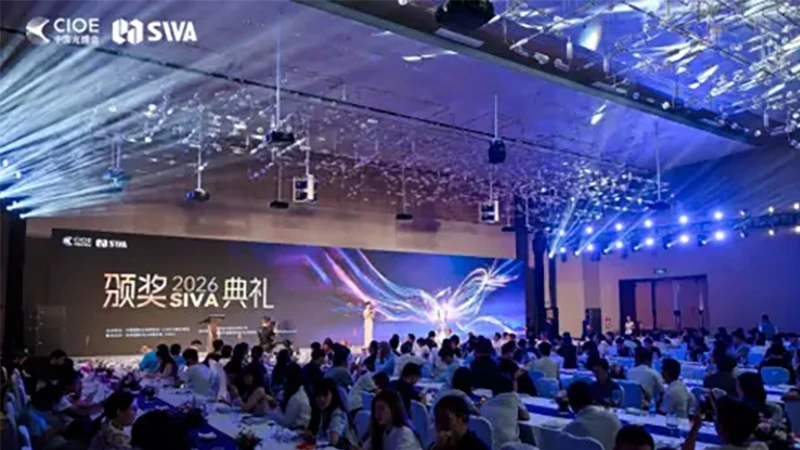
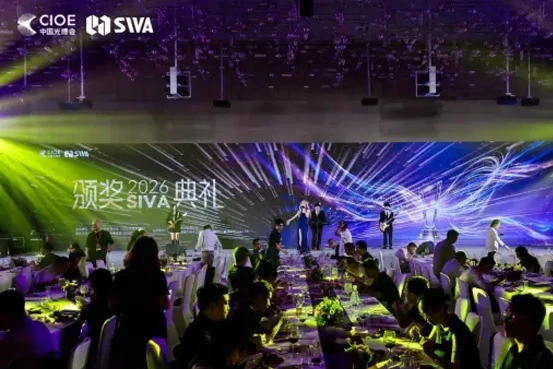
On the evening of September 9, the winners of the SIVA Awards 2026 were announced.
The awards spanned 12 categories, with a panel of 10 judges from academia, industry, and media evaluating entries based on criteria such as ergonomics and wearing comfort, industrial design and aesthetics, software functionality and utility, and commercial value and market potential, ultimately selecting 62 winners.
In terms of product categories, end-user devices accounted for 18 awards (29% of the total): 7 for AR Glasses of the Year, 6 for AI Camera Glasses of the Year, and 5 for MR Headsets of the Year.
There are 11 awards in the upstream category, comprising 3 for Best AR Optical Solution of the Year, 3 for Optical Technology Breakthrough of the Year, and 5 for Best Micro-display Solution of the Year. The enterprise category includes 18 awards: 5 for Most Technologically Innovative Enterprise of the Year, 6 for Enterprise with Greatest Commercial Potential of the Year, and 7 for Influential VR/AR Enterprise of the Year. The content and operations category features 15 awards: 4 for Best VR Film of the Year, 6 for Best Large-scale VR/MR Experience of the Year, and 5 for Best Large-scale VR Experience Operator of the Year.
Eyewear emerged as the category with the highest concentration of awards, underscoring that the consumer-facing interface remains a focal point for the industry; meanwhile, the simultaneous recognition of upstream optical and display technologies highlights the growing importance of the supply chain.
Viewed against the backdrop of the industry, data from research firms such as WellsennXR—a supporting organization for the conference—indicate that global shipments of AI glasses are projected to reach approximately 8.7 million units in 2025, a year-on-year increase of over 300%. AI glasses are expected to account for roughly 88% of total smart glass shipments, with the Chinese supply chain representing over 80% of global suppliers in this sector. These figures demonstrate that competition surrounding new products is not merely about isolated showcases; rather, it is part of a continuous progression built upon supply chain scale, channel exploration, and capital investment.
When these components are mapped out together, the "critical turning point" envisioned for SIVA 2026 ceases to be an abstract slogan. The rapid growth of AI glasses fosters a user base and instills confidence across the supply chain; spatial computing and large-scale spatial operations unlock potential use cases and revenue streams; and engineering advancements in optics and micro-displays lay the groundwork for lightweight devices and viable display performance.
Beyond the tipping point, competition shifts from mere conceptual demonstrations to actual delivery capabilities. Success belongs to those who can make devices lighter, ensure stable battery performance, and deliver practical display functionality; those who can standardize content replication; and those who can sustain a steady flow of orders and investment. When exhibitions, conferences, capital, and orders converge on a single platform, the "tipping point" ceases to be merely a moment in time—it becomes a set of verifiable industry actions.
The event has concluded, but the journey continues: the tipping point is behind us, and the next exciting chapter for XR is just beginning.

Please log in to your member account first. *


0 Comments