
By: Steve-
On: 01 May 2026





| Sub-Total : | $23.30 |
| Eco Tax (-2.00) : | $4.52 |
| VAT (20%) : | $5.66 |
| Total : | $33.48 |
By: Steve-
On: 01 May 2026
On April 28, the “China AI Hardware Industry Trends Conference and 2025 IoT Star Awards Ceremony,” themed “Hardware Awakening · Intelligent Evolution,” was successfully held in Shenzhen. The conference was organized by the Shenzhen Internet of Things Industry Association, the WAIA Alliance, AGIC, and IOTE, co-organized by the Shenzhen Toy Industry Association and the Shenzhen Smart Terminal Industry Association, and hosted by IoT Media, New Hardware Insights, and Visual IoT, with title sponsorship provided by Ant Digital Technology. Over 750 professionals from the AI hardware industry chain attended the event, and 17 outstanding AI hardware manufacturers exhibited their products.
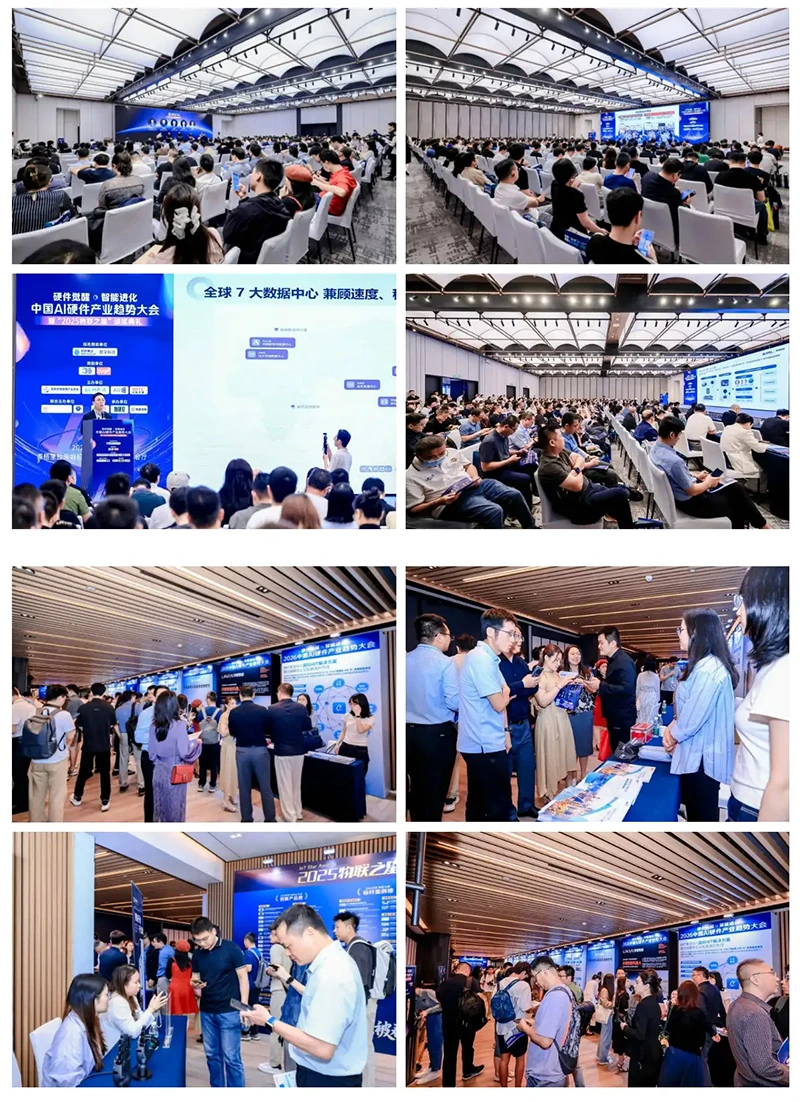
Opening Remarks by Yang Weiqi, Executive President of the Shenzhen Internet of Things Industry Association, and Signing Ceremony
Yang Weiqi pointed out that 2026 marks the 70th anniversary of the birth of the concept of artificial intelligence. Since the concept was first proposed at the Dartmouth Conference, AI has undergone multiple technological iterations and has now entered the era of general artificial intelligence centered on large language models, becoming a key engine driving the Fourth Industrial Revolution. Over the past three years, AI technology has developed exponentially, with the continuous emergence of smart wearables, AI toys, and embodied robots, presenting the industry with an opportunity for transformation.
Against this backdrop, “In the AI era, every piece of hardware deserves to be redefined.” Leveraging China’s comprehensive industrial chain and manufacturing strengths, the convergence of AI and hardware is driving unprecedented industrial upgrades and presenting opportunities to “overtake competitors on a curve.” This conference aims to help enterprises grasp trends, connect resources, and find partners.
Yang Weiqi also announced the 25th International IoT Expo & AGIC General Artificial Intelligence Expo (hereinafter referred to as the IOTE & AGIC Expo), scheduled to take place in Shenzhen from August 26 to 28 this year. The event is expected to bring together over 1,000 exhibiting companies and more than 100,000 professional visitors, covering the entire industrial chain of AI, IoT, embodied intelligence, and AIoT, to create a one-stop platform for procurement and networking.
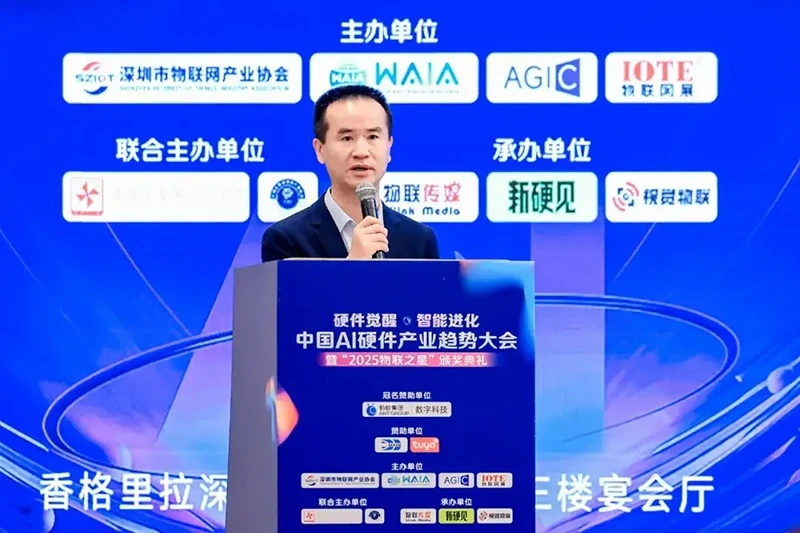
Yang Weiqi, Executive President of the Shenzhen Internet of Things Industry Association
Subsequently, Yang Weiqi, representing the IOTE & AGIC Expo, presided over signing ceremonies with the Shenzhen Toy Industry Association and the Shenzhen Children’s Intelligent Industry Association. Liu Zhenlie, President of the Shenzhen Toy Industry Association, and An Zineng, President of the Shenzhen Children’s Intelligent Products Association, attended the event. Notably, this year’s IOTE & AGIC Expo will feature the newly established “Shenzhen (International) AI Toy Ecosystem Zone (AITE)” and the “2026 International Children’s Intelligent Industry Ecosystem Zone.”
Session 1: “Connecting the Infinite, Creating a Win-Win Ecosystem: A Comprehensive Overview of Ant Digital Technology's IoT Solutions”
Speaker: Lu Weiqi, General Manager of the IoT Ecosystem Development Department, China Business Division, Ant Digital Technology
Lu Weiqi pointed out that Ant Digital Technology has long been dedicated to developing core technological capabilities, establishing a systematic presence in fields such as blockchain, privacy computing, and AI, while continuously driving the deep integration of IoT with payments, AI, and industrial applications. Specifically, in the “IoT + Payments” sector, the company has leveraged secure chip solutions to enable convenient payments on wearable devices and facilitate their adoption in public transportation scenarios, significantly enhancing the user experience.
Looking toward the AI era, smart hardware is exhibiting three major trends: first, the comprehensive intelligent upgrade of traditional hardware; second, the emergence of new terminal forms represented by AI glasses and companion devices; and third, the reshaping of hardware business models to transform terminals into gateways for computing power and services. In Lu Weiqi’s view, the “loneliness economy,” “silver economy,” and emotional companionship scenarios will become key growth areas.
In practice, Ant Digital Technology is driving the integration of AI with diverse scenarios, including cultural tourism, job search services, and medical assistance, using digital avatars and multimodal interactions to improve service efficiency and user experience. Meanwhile, in the consumer electronics sector, the company is providing integrated hardware-software solutions for AI glasses and AI toys to accelerate product commercialization. Furthermore, in industrial digitalization, Ant Digital Technology is exploring the application of IoT in sectors such as two-wheeled vehicles and new energy, leveraging data and risk control capabilities to empower sales and financial services. Through “IoT + blockchain,” the company enables device on-chain registration and asset title verification, enhancing asset transparency and financing efficiency—currently serving over 10 million devices.
Lu Weiqi stated that AI is endowing IoT with greater intelligence and “human touch,” and that hardware will become a key gateway to intelligence in the future. Ant Digital Technology will continue to open up its technological and ecosystem capabilities, collaborating with industry partners to jointly explore hardware innovation and business opportunities in the AI era.
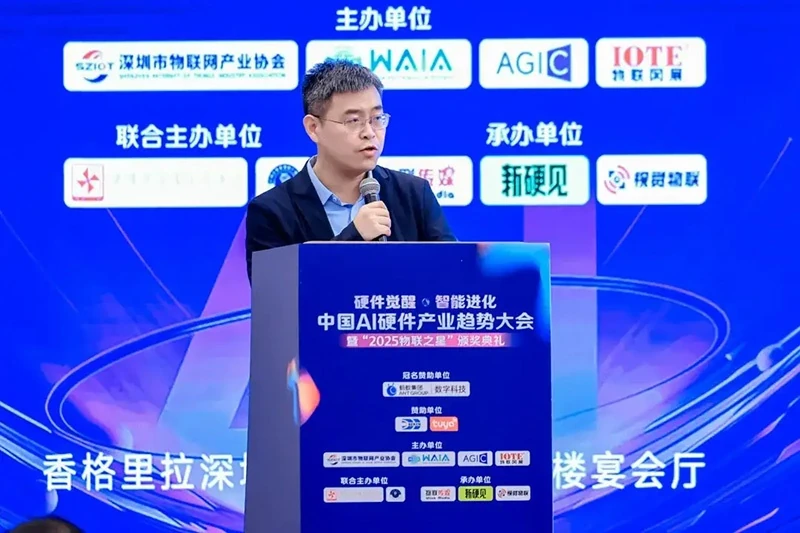
Lu Weiqi, General Manager of the IoT Ecosystem Development Department, China Business Division, Ant Digital
Session 2: “Connecting Through Chips: Building a New Hardware Ecosystem Together”
Speaker: Liu Lianxue, General Manager of Broadcom Integrated Circuits (Shenzhen)
Liu Lianxue pointed out that with the rapid penetration of AI technology, edge AIoT chips are becoming a key foundational capability for the upgrade of smart hardware. As a manufacturer of wireless connectivity and edge AI chips, Broadcom Integrated Circuits is continuously strengthening its integrated capabilities in “connectivity + computing + multimedia processing.”
As one of the fastest-growing market segments, AI toys are expected to maintain rapid growth in the coming years, with educational companion, STEM, and IP-interactive products accounting for approximately 80% of the market share. As AI penetration increases, the industry is placing higher demands on capabilities such as low latency, offline interaction, data security, and low power consumption.
In terms of technological evolution, AI hardware is transitioning from the voice interaction stage—where devices “can hear and speak”—to the multimodal stage, where they “can see and move.” The introduction of visual capabilities will significantly expand application boundaries, including facial recognition, gesture recognition, and behavioral understanding, and drive greater market growth. Broadcom Integrated Circuits is focusing on strengthening edge-side vision and AI computing capabilities by integrating MCUs, NPUs, multimedia processing units, and Wi-Fi and Bluetooth connectivity into its chips, thereby enabling integrated support for voice, vision, and interaction.
Liu Lianxue also highlighted the company’s AI chip product roadmap: the earliest chip, the BK7252N, addressed voice dialogue needs, while the BK7258 added video display and local voice wake-up capabilities. The BK7259 will further enhance NPU and image signal processing (ISP) capabilities, with mass production and release scheduled for July of this year. Among commercially available products, Luobo Intelligence’s “Fuzozo” AI toy and Phancy AI glasses have adopted the BK7258 solution.
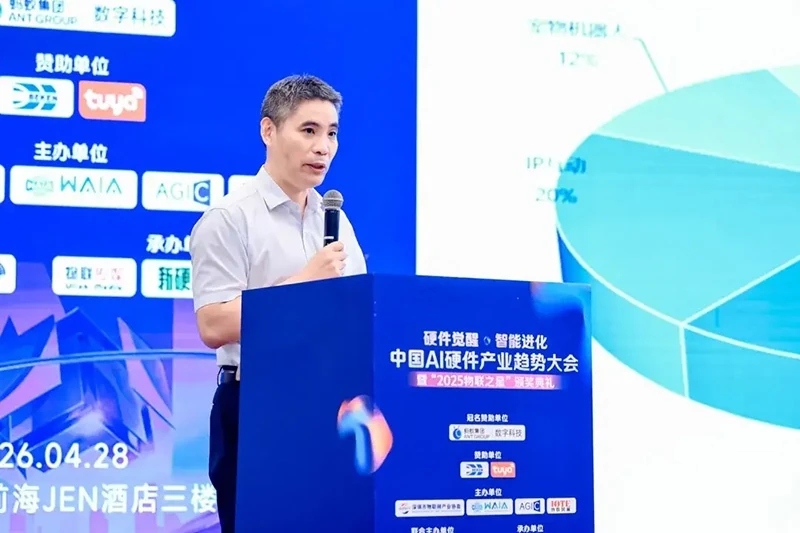
Liu Lianxue, General Manager of Broadcom Integrated Circuits’ Shenzhen Subsidiary
Session 3: “The Evolution of Physical AI: How AI Helps Hardware Understand You Better”
Speaker: Zhang Tao, Head of the AI Audio-Video Division at Tuya Smart
Zhang Chen pointed out that as the company advances its “All in AI” strategy, Tuya is accelerating its transformation from a traditional IoT connectivity platform into an open ecosystem platform for the AI era, with its core mission remaining “connecting upstream and downstream players, lowering barriers to entry, and empowering partners.” Over the past decade, Tuya has primarily focused on the smart home sector, connecting over 1 billion IoT devices worldwide and building a solid foundation in communication protocols, cloud platforms, and global compliance. In the AI era, this infrastructure will serve as a crucial foundation for driving the intelligent upgrade of hardware.
The AI era is not simply about connecting devices to large language models; it requires a fundamental restructuring of the relationship between hardware and users. If products remain limited to “conversational capabilities,” they will struggle to maintain sustained engagement. AI hardware must possess multimodal perception and the ability to provide long-term companionship. Zhang Tan proposes that IoT is transitioning from the 2.0 stage of “device connectivity” and “scenario integration” to the 3.0 stage of “seamless intelligence”—where devices can proactively understand user habits and provide services without explicit commands, achieving an experience upgrade that is “as subtle as rain nourishing the earth.”
Based on this trend, the core of future AI hardware lies not in the capabilities of individual devices, but in system-level collaboration. Zhang Tao proposed the concept of “multi-agent collaboration”: each device will become an agent with independent intelligence, interconnected and collaborating through a platform, and coordinated by a higher-level agent to form a holistic intelligent experience across devices and scenarios.
In terms of implementation, Tuya continues to position itself as an open platform. By integrating resources from cloud, chip, and device manufacturers, it lowers the barrier to AI hardware development, promotes interoperability among devices of different brands and form factors, and accelerates the large-scale adoption of AI companions and consumer-grade smart hardware.
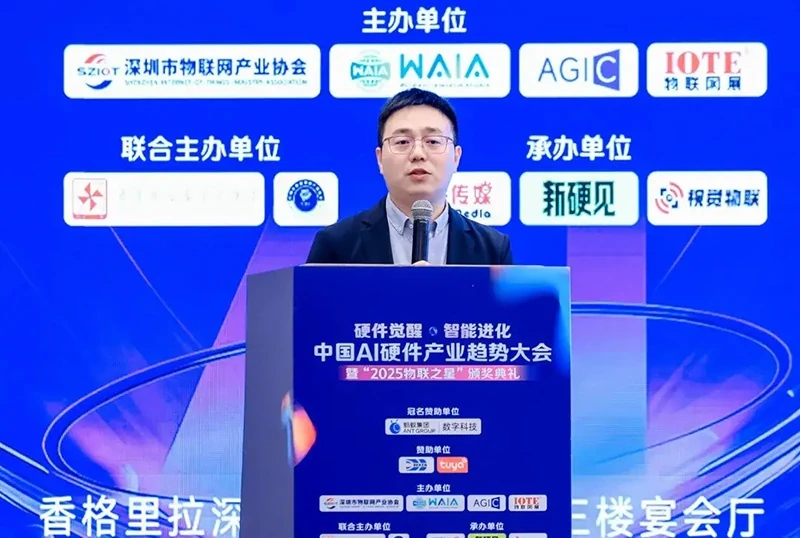
Zhang Tao, Head of the AI Audio-Video Division at Tuya Smart
The launch ceremony for the Shenzhen Internet of Things Industry Association’s “Challenge-Based Recruitment” initiative for group standard innovation was officially held.
Six standards proposed by the Shenzhen Internet of Things Industry Association have been successfully selected for the 2026 municipal-level list, covering cutting-edge fields such as virtual power plants, AIGC security, and computing power services. At the meeting, the leaders of the six standard-setting initiatives—Chen Tunan, a technical expert from the Shenzhen Power Supply Bureau; Wang Xingjun, a National High-Level Talent and researcher at Tsinghua University’s Shenzhen International Graduate School; and Li Yuanhong, Deputy Director of the Emerging Industries Standardization Research Institute at the Shenzhen Institute of Standardization—presented their respective standards in turn.
Following that, Yu Rongfang, Deputy Director of the Standards Division at the Shenzhen Market Supervision and Administration Bureau; Peng Xuefeng, Senior Researcher at the Bao’an District Artificial Intelligence Industry Office; Yang Weiqi, Executive President of the Shenzhen Internet of Things Industry Association; Wang Xingjun, a nationally recognized high-level talent and researcher at Tsinghua University’s Shenzhen International Graduate School; and Li Yuanhong, Deputy Director of the Emerging Industries Standardization Research Institute at the Shenzhen Standards and Technology Research Institute, and Chen Tunan, Technical Expert at the Shenzhen Power Supply Bureau, took the stage to jointly launch the Shenzhen Internet of Things Industry Association’s “Challenge-Based” Group Standard Innovation Initiative. This project will be jointly developed with partners from Hong Kong and Macao to establish common standards for the Greater Bay Area, empowering the AI hardware and digital energy industries through standard innovation, and contributing to the high-quality development of the Guangdong-Hong Kong-Macao Greater Bay Area.
Roundtable Forum 1: Embodied Intelligence
Moderator: Zhang Zhongliang, Head of AIoT StarMap Research Institute
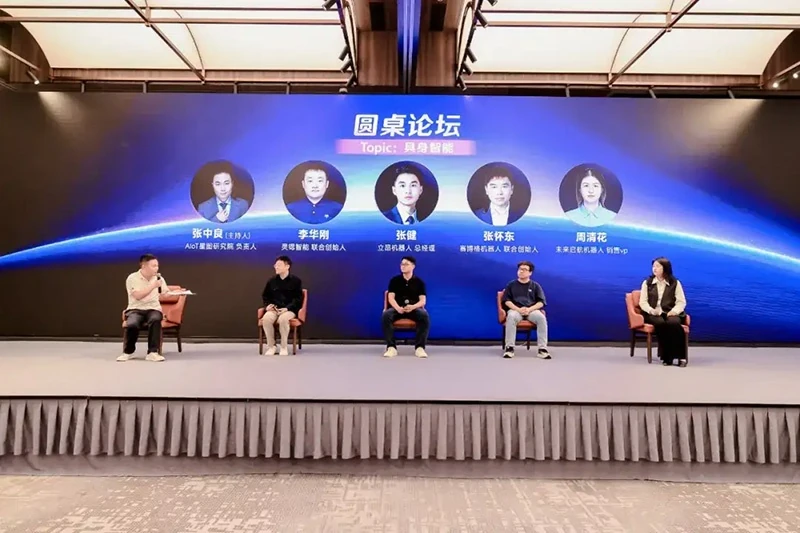
Panelists: Li Huagang, Co-founder of LingSi Intelligence; Zhang Jian, General Manager of Lian Robot; Zhang Huai Dong, Co-founder of Cyborg Robot; Zhou Qinghua, VP of Sales at Future Voyage Robotics
During the roundtable session moderated by Zhang Zhongliang, representatives from several robotics companies discussed technical bottlenecks and commercialization pathways.
Li Huagang pointed out that robotics is still in its early stages, with the industry currently focused primarily on “motion control (the cerebellum),” while “end-to-end task processing capabilities (the brain)—which truly determine the success of practical applications—still require breakthroughs. Meanwhile, approximately half of the hardware costs are concentrated in the joint systems, where performance and reliability have become key constraints. In terms of commercialization, the company’s heavy-load robotic dogs have already been deployed in over a dozen scenarios, including public security and firefighting.
From an industrial implementation perspective, Zhang Jian noted that “data acquisition” is one of the major bottlenecks at present. After visiting dozens of factories, the team discovered that collecting real-world production line data is costly and prone to interference, posing a core challenge to model training. The company is addressing this challenge through low-cost data collection solutions and expects to launch related products in June of this year. Zhang Jian stated that the company is advancing commercialization through a three-phase model of “components first, data follow, and solution implementation,” starting with controllers and algorithm boxes before gradually expanding to data and complete system solutions.
Zhang Huai-dong also emphasized the importance of data, particularly in specialized industries such as gas and pipelines, where a severe lack of standardized datasets has led to low success rates in precise operations (such as turning knobs and valves). He believes that neither reinforcement learning nor world models are currently mature, stating that “data remains the biggest variable.” In terms of business models, the company prefers to provide integrated hardware-software solutions to improve implementation efficiency. Additionally, Zhang Huai-dong estimates that the robotics market could reach a scale 100 times larger than the automotive industry, though this will require several decades of development.
Zhou Qinghua, speaking from the perspective of frontline implementation, pointed out that currently about 95% of orders are still concentrated in scenarios such as universities and inspection tasks, and the industry has not yet entered a phase of large-scale profitability. The company adopts an “order-driven + cost-recovery” model; for example, it uses a 2,000-unit order to retroactively optimize supply chain costs. She also believes that while robots are unlikely to achieve automotive-level penetration in the short term, they are expected to enter household scenarios within 20 years in the form of “home appliances,” gradually penetrating the market as single-function devices.
Roundtable Discussion 2: AI Glasses
Moderator: An Zineng, Executive President of the Shenzhen Intelligent Terminal Industry Association
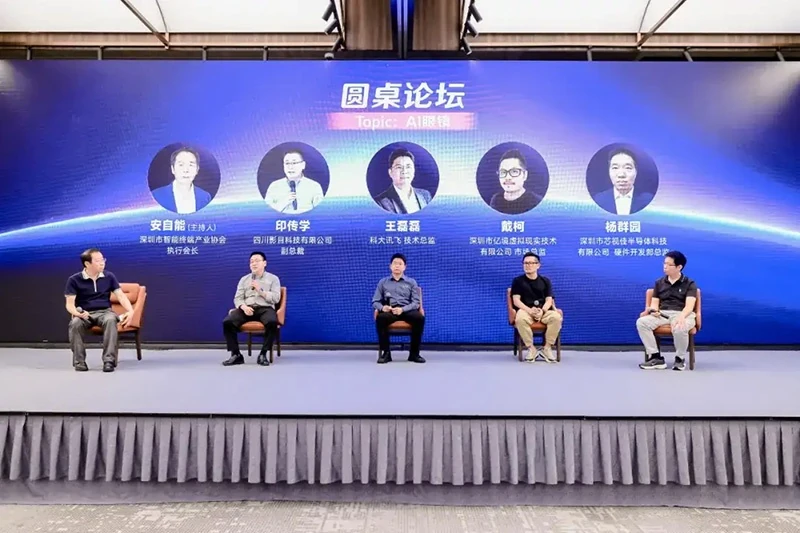
Panelists: Yin Chuanxue, Vice President of Sichuan Yingmu Technology Co., Ltd.; Wang Leilei, Technical Director of iFlytek; Dai Ke, Marketing Director of Shenzhen Yijing Virtual Reality Technology Co., Ltd.; Yang Qunyuan, Director of Hardware Development at Shenzhen Xinshijia Semiconductor Technology Co., Ltd.
As the host, An Zineng began by presenting key industry data: global shipments of AI glasses are projected to reach approximately 7.5 million units in 2024, with an expected doubling to 15 million units in 2025.
From a hardware perspective, Yin Chuanxue pointed out that AI glasses face the “impossible triangle” of “lightweight design, battery life, and computing power,” with current products still limited to tech enthusiasts. He offered a key insight: AI applications are reshaping hardware development paths by reducing reliance on local computing power and display capabilities, driving devices toward lighter designs and accelerating their transition from a niche market to the mainstream.
Wang Leilei, however, presented a “counterintuitive” viewpoint: The industry should not simply add more features but should return to the essence of wearables—“comfort first, intelligence second.” He emphasized that low-power algorithms and system optimization are more important than simply piling on computing power. At the same time, he elevated privacy issues to a core industry risk, arguing that a major privacy incident could cause systemic shock to the entire industry, necessitating the establishment of a mechanism that is “perceptible, authorizable, and traceable.”
Dai Ke categorized AI glasses into three product types: audio, camera, and display. He emphasized that fashion is a fundamental attribute of eyewear, with weight and design taking precedence over functionality. Regarding camera privacy concerns, Dai Ke suggested that glasses need not blindly pursue high-resolution cameras, as the requirements for multimodal capabilities are relatively low.
Yang Qunyuan noted that the success of products like Ray-Ban Meta and Even Realities G1 suggests the industry has room to streamline its offerings. For instance, by eliminating full-color displays and simplifying camera systems, manufacturers can first achieve lighter weight and longer battery life, then gradually iterate on functionality. He also mentioned that privacy protection is moving toward hardware-level constraints, with features such as photo indicator lights and mandatory shutter sounds becoming industry standards.
Roundtable Discussion 3: AI Toys
Moderator: Chen Xingrong, Secretary-General of the Greater Bay Area AI Special Committee, Shenzhen Toy Industry Association
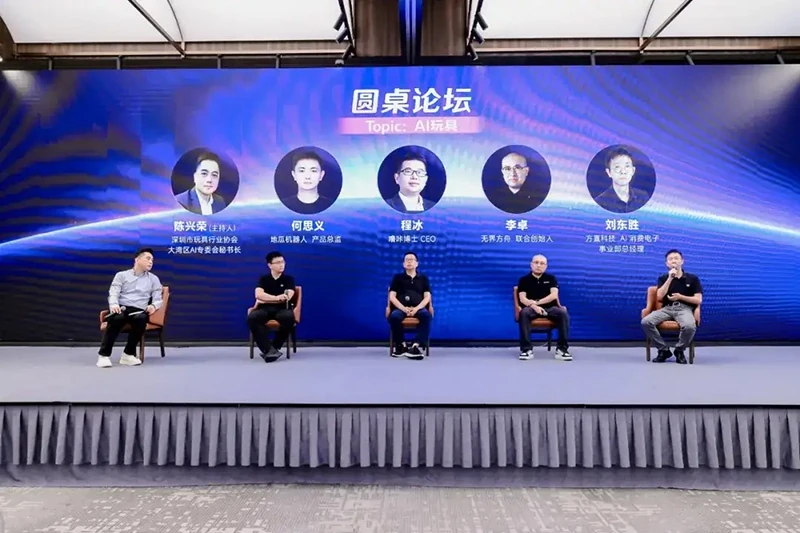
Panelists: He Siyi, Product Director at Sweet Potato Robotics; Cheng Bing, CEO of Dr. Luka; Li Zhuo, Co-founder of Boundless Ark; Liu Dongsheng, General Manager of the AI Consumer Electronics Division at Fangzhi Technology
Chen Xingrong engaged in an in-depth discussion with the guests in attendance regarding the current state, product logic, and future trajectory of AI toys.
From a foundational technology perspective, He Siyi argued that AI toys are essentially a generalized form of “AI + entertainment.” While the market is growing rapidly, he identified two core challenges: first, “more AI”—that is, how to effectively implement cutting-edge capabilities such as agents and multimodal processing in specific scenarios; and second, user retention. Furthermore, the evolution of AI toys has progressed from “single-modal voice dialogue” to a multimodal interaction phase involving “dialogue + facial expressions (eye contact) + gestures,” and may expand further into more complex embodied interactions in the future.
Cheng Bing directly addressed the issue of “false demand” in the industry, noting that a large number of AI toys currently remain at the superficial level of “AI plus a plush exterior,” essentially lacking in product quality. “Often, adults assume children need these products, but the actual users aren’t buying into them.” He emphasized that the core of such products must either provide emotional value or become essential tools. In its actual operations, Dr. Luka needs to continuously adjust its direction based on data such as daily active users and retention rates, rather than relying on subjective judgment.
Li Zhuo approached the issue from the perspective of industry structure, pointing out that AI toys are currently in a phase where “technological implementation and market demand are converging,” but homogenization has rapidly emerged within just six months. He summarized two major challenges: first, “difficulty in technological integration,” which involves a systematic engineering effort combining ID design, materials, craftsmanship, and AI; second, “difficulty in business models,” particularly the challenges of adapting the “hardware + subscription” model in the domestic market. The corresponding strategy is to define products with the user at the core and repeatedly validate needs through real-world scenarios such as kindergartens and elementary schools.
Liu Dongsheng, meanwhile, offered more pragmatic observations from the perspectives of commercialization and supply chain. He pointed out that within just three years, the AI toy market has entered a highly competitive phase where “dozens of new models are launched every month,” resulting in extremely high user choice costs; brands must prioritize establishing a “place in the user’s mind.” At the same time, he emphasized that companies are currently facing dual pressures from rising hardware costs (such as increasing memory prices) and online customer acquisition costs. To balance these costs, companies need to strengthen offline channels and control marketing expenditures, while adhering to the principle of “quality over scale”—a principle that must never be compromised, especially when it comes to children’s products.
“2025 IoT Star” Annual Awards Ceremony
As an authoritative and influential annual ranking in China’s AIoT sector, the “IoT Star” list aims to recognize outstanding enterprises, products, case studies, and individuals for their achievements in the integration and innovation of the Internet of Things and artificial intelligence. The 2025 “IoT Star” selection coincides with a pivotal moment in China’s IoT industry as it transitions from “Interconnection of All Things” to “Intelligent Interconnection of All Things.” The winning companies not only represent the concentrated achievements of AIoT innovation over the past year but also serve as key drivers of the industry’s future evolution.
Once again, congratulations to all the winning companies of the “IoT Star 2025” awards. We also look forward to seeing even more innovative companies take the stage at the “IoT Star” awards in 2026, as we work together to write a new chapter in the history of AIoT!
Following the conclusion of the summit, the organizers hosted a dinner for invited guests at the event venue. Yang Weiqi, Executive President of the Shenzhen Internet of Things Industry Association, and Lu Weiqi, General Manager of the IoT Ecosystem Development Department at Ant Digital Technology’s China Business Division, delivered speeches at the dinner. Discussions on AIoT and AI hardware remained lively throughout the event, and guests were able to connect with resources across the industry chain in a relaxed and enjoyable atmosphere.
Source: Shenzhen Internet of Things Industry Association Durian

Please log in to your member account first. *


0 Comments