

By: Jo Van-
On: 09 Nov 2026


| Sub-Total : | $23.30 |
| Eco Tax (-2.00) : | $4.52 |
| VAT (20%) : | $5.66 |
| Total : | $33.48 |
By: Jo Van-
On: 09 Nov 2026
Distributors, electronics retailers and brand teams evaluating smart eyewear quickly run into a category problem: AI camera glasses, AR display glasses and audio smart glasses are often presented as one product type, yet they differ sharply in hardware complexity, software dependency and the customer each one actually serves. Choosing the wrong mix for your channel means slow sell-through, heavy support load and returns you did not budget for. This guide breaks the three families down on the criteria that matter to buyers — use case, hardware trade-offs, customization, sampling and assortment planning — without declaring a single winner.
Audio smart glasses put open-ear speakers, a microphone and Bluetooth connectivity into a frame. There is no camera and no display. The product is closest to a familiar accessory, and the buying decision is driven by comfort, sound leakage and battery life.
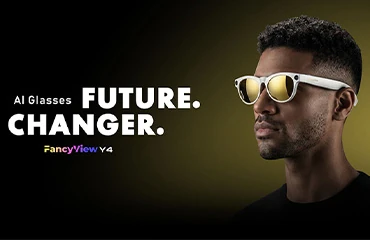
AI camera glasses add an image sensor and, typically, on-device or companion-app processing for capture, translation, object recognition or voice-assistant features. The glasses become a wearable input device, and the software roadmap matters as much as the frame.
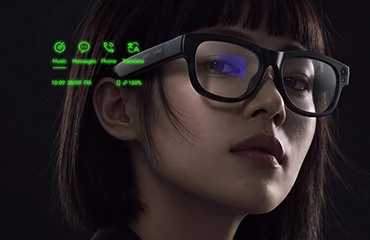
AR display glasses introduce an optical system that projects information into the wearer's field of view. This is the most hardware-intensive category, with the widest gap between a convincing demo and a shippable retail product.
If you are mapping suppliers and specifications across these families, our overview of smart glasses is a useful starting point before you narrow to a specific architecture.
Everyday commuters and office users who want calls and audio without earbuds.
Sports and outdoor buyers who need situational awareness while listening.
Corporate gifting and uniform programs where simplicity and low support cost matter.
The customer benefit is easy to explain in a few seconds, which makes this family the lowest-friction entry point for most retail channels and the easiest to merchandise in store.
Field service, inspection and documentation workflows where hands-free capture is genuinely useful.
Content creators and prosumers who want point-of-view recording.
Accessibility and language-support scenarios, depending on the software stack.
These products sell on capability, so the channel needs a convincing demonstration and clear, honest guidance on what the device does and does not do. Buyers should expect more pre-sales education and more after-sales questions than with audio-only frames.
Training, remote assistance and guided workflow deployments.
Industrial and enterprise pilots where the display replaces a handheld screen.
Early-adopter consumer segments in markets with appetite for premium devices.
AR is rarely a volume-first category. It rewards buyers who can support a specialist sales motion and who have a clear answer for what the customer will display on day one. Our AR/VR/XR glasses range overview is the right reference if you are evaluating optical approaches.
Every added function costs something in wearability. The table below summarises the practical differences buyers should test rather than assume.
| Attribute | Audio smart glasses | AI camera glasses | AR display glasses |
|---|---|---|---|
| Weight and balance | Closest to ordinary eyewear; front-heavy frames are avoidable | Noticeably heavier at the front; hinge and temple design matter | Heaviest; weight distribution and nose-bridge pressure are critical |
| Battery expectations | Small cell is often sufficient for a full listening day | Capture and wireless transfer draw current quickly; charging routine is part of the product | Display plus compute creates the highest consumption and the most heat |
| Thermal behaviour | Usually minor; speakers and radios generate limited heat | Concentrated near the camera module and processor during sustained recording | Most sensitive; heat can affect comfort and perceived performance |
| Fit and prescription options | Widest range of frame shapes and lens options | Constrained by module placement; lens compatibility varies | Most constrained; optical design limits frame variety |
| Typical support burden | Pairing and firmware updates | Pairing, storage, privacy settings and app updates | All of the above plus calibration and display troubleshooting |
A useful rule for buyers: the more the product asks the wearer to change their daily habits — charging, pairing, adjusting fit — the more of your margin goes into customer education.
Camera glasses raise questions of field of view, low-light behaviour, recording indicators and where footage is stored. Buyers should confirm how the device signals that recording is active, because visible indicators are both a usability feature and a social-acceptance feature. Storage strategy — on-device versus phone-side — affects the app dependency described below.
AR display quality is not a single specification. Brightness, contrast, transparency, eye-box size and how the image behaves in daylight all interact, and a configuration that looks strong in a meeting room may disappoint outdoors. Buyers should judge the display in the environment where the end customer will actually use it, not only in a demo setting.
Audio glasses can function as a largely self-contained Bluetooth accessory. AI camera glasses usually depend on a companion app for setup, transfer and feature updates. AR display glasses may depend on a host device, a management platform or an SDK. Each layer of dependency is a support obligation and a roadmap risk — ask suppliers directly about update policy, app maintenance commitments and what happens to the product if the app is discontinued.
| Dimension | Audio smart glasses | AI camera glasses | AR display glasses |
|---|---|---|---|
| End-customer benefit | Immediate and easy to explain | Capability-driven; needs demonstration | Workflow-driven; needs a defined use case |
| Hardware complexity | Low to moderate | Moderate to high | High |
| App dependency | Low | Moderate to high | High |
| Privacy considerations | Limited; microphone handling still matters | Significant; recording indicators, consent and data handling | Significant; often includes camera plus workplace data |
| Validation priorities | Fit, audio leakage, battery, pairing stability | Image quality, thermal behaviour, app reliability, indicators | Optical performance, weight, heat, calibration, SDK support |
| Best-fit channel | Broad retail, lifestyle, gifting, uniform programs | Specialist retail, prosumer, vertical B2B pilots | Enterprise and industrial specialists, selected premium retail |
Camera-enabled eyewear attracts more scrutiny than any other wearable category in this group. Buyers should treat privacy as a product specification, not a legal afterthought. Confirm what data leaves the device, whether recordings are encrypted, how the companion app handles permissions and what user documentation explains acceptable use. Requirements differ by market and by customer segment, so validate against your own regulatory obligations and local legal advice rather than relying on a supplier's general statement. Where a supplier references certifications, ask for the underlying documentation and verify it independently.
The three families are not sourced in the same way. Audio frames sit in a mature accessory supply chain with many capable factories. AI camera glasses require firmware and app capability alongside hardware assembly, and the quality of that software work is often the real differentiator between suppliers. AR display glasses concentrate on a smaller number of optical specialists, longer development cycles and higher tooling commitments.
Before committing, verify the following:
Capability fit: does the supplier build the whole product, or assemble modules from third parties?
Software ownership: who maintains the app or SDK, and for how long?
Documentation: are user manuals, safety information and privacy notices available in your target languages?
Change control: how are component substitutions and firmware changes communicated after the order is placed?
Support terms: what is the defect process, and what response time is agreed in writing?
Consistency: can the supplier show that pilot units and mass-production units come from the same specification?
For buyers new to the category, our AI smart glasses line and FAQ section answer the most common specification and ordering questions.
Customization depth follows hardware complexity. Audio glasses offer the widest scope for frame shape, colour, lens tint, packaging and branding at accessible minimums. AI camera glasses allow meaningful customization in housing finish, branding, packaging and sometimes firmware feature sets, but module placement constrains industrial design. AR display glasses typically allow the least cosmetic flexibility and the longest sampling cycle.
Wear each sample for at least a full working day, not five minutes, and record comfort at the bridge and temples.
Run a full battery cycle under realistic use, including standby drain.
Measure heat at the contact points during sustained use, particularly for camera and display models.
Test pairing and app setup on the phone models your customers actually use.
For camera models, check image quality indoors, outdoors and in low light, and confirm the recording indicator behaves as described.
For AR models, evaluate the display in daylight, in motion and during extended sessions.
Check audio leakage at typical listening volumes on audio models.
Review the packaging, quick-start guide and privacy documentation as a customer would.
Run a small internal blind test with colleagues outside the buying team and capture their objections verbatim.
Request a second production-run sample to confirm consistency before placing a bulk order.
A balanced first order reduces risk without diluting the range. A practical pattern for many distributors and retailers looks like this:
Anchor on audio: use one or two audio smart glasses SKUs to establish category presence at accessible price points and low support cost.
Add one AI camera model as the feature and margin story, with staff training and a clear demo routine in place before launch.
Hold AR as a controlled pilot unless you have a specialist channel: limited units, a named target customer segment and a defined use case.
Keep total SKU count small in the first cycle. Depth in accessories, lenses and colours usually sells better than breadth across unfamiliar product types, and it gives you cleaner data on which family deserves the second order.
There is no universal answer, but distributors and retailers without an existing wearable business usually find audio smart glasses the simplest to launch, because the benefit is immediate and the support load is lower. Buyers with a specialist or enterprise channel may find AI camera or AR products a better strategic fit.
No. AI glasses typically focus on capture, voice interaction and assisted features, often without a display. AR glasses add a visual overlay. Some products combine both, so always check the specification rather than the marketing label.
Accept dependency in proportion to the benefit it delivers, and always in writing. Ask for the update policy, expected support period and a contingency plan if the app is discontinued.
Branding, packaging, colour and lens options are commonly available on audio and camera models. Deep industrial-design changes and custom optics typically require longer timelines and higher commitments.
Plan for iterative sampling rather than a single round. Audio models usually move fastest; camera models need software validation; AR models should be treated as a development project with clear milestones.
Tell us your channel, target customer and volume range, and we will recommend a first assortment across audio, AI camera and AR display options, along with the sampling plan and documentation you need to evaluate it properly. Contact our team to request a quote and start your sample evaluation.

Please log in to your member account first. *


0 Comments