
By: Steve-
On: 13 May 2026





| Sub-Total : | $23.30 |
| Eco Tax (-2.00) : | $4.52 |
| VAT (20%) : | $5.66 |
| Total : | $33.48 |
By: Steve-
On: 13 May 2026
According to IDC data, shipments of smart glasses in China are expected to reach 2.46 million units in 2025, representing a year-over-year increase of 87.1%—far exceeding the global growth rate of 44.2%. IDC also forecasts that Chinese brands’ share of the global AI glasses market is expected to reach 45% in 2026, with global shipments by Chinese brands reaching 22.67 million units, up 56.3% year-over-year.
The capital markets are not merely concerned with how many units can be sold, but rather whether AI glasses will become the hardware form factor closest to the “next-generation personal computing gateway” following the smartphone. Whoever secures dominance in visual, voice, spatial perception, and agent invocation may gain control over the next round of traffic distribution.
Smart glasses aren’t a new accessory;
what tech companies are after is “low-friction interaction.”
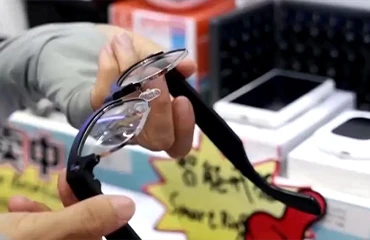
If you look solely at the product’s form factor, it does indeed resemble a smarter pair of glasses: it can take photos, record videos, play music, translate, recognize objects, answer questions, and provide navigation. Some models can even handle payments, meeting summaries, and first-person video recording. But what the big tech companies are really after isn’t selling one more electronic accessory—it’s pulling AI assistants out from behind smartphone screens.
The smartphone’s strength lies in its versatility, but its shortcomings are equally clear: users must take it out, turn it on, unlock it, and open an app. The potential of AI glasses lies in their wear time and real-time awareness. Translation no longer requires pointing a phone at a menu; meeting summaries don’t need separate recordings; navigation alerts eliminate the need to look down at a screen; and object recognition and search can shift from “snap and upload” to “ask as you see.”
This also represents the fundamental shift in the AI glasses competition in 2026: the industry is shifting from “whether it has a display” to “whether it can be worn all day and whether AI can be accessed at any time.” A recent analysis by 36Kr shows that domestic screenless AI glasses are collectively betting on lightweight designs. The Huawei AI glasses frame weighs 35.5g, while the frames of Xiaomi AI Glasses, Quark G1, Xiaodu AI Glasses Pro, and Li Livis are mostly kept under 40g; the Ray-Ban Meta Gen2, already in mass production overseas, weighs approximately 52g. Domestic mainstream screenless products are already beginning to differentiate themselves in terms of wearing comfort.
This detail is crucial. For AI glasses to become a gateway device, the first step is not to lead in technical specifications, but to make users willing to wear them for extended periods. The problem with VR and AR headsets in the past was that while they were highly capable, the cost of wearing them was too high. By choosing to de-emphasize displays and instead strengthen voice and visual perception, AI glasses are actually taking a more pragmatic approach: securing the gateway first, then waiting for displays, battery life, chips, and the ecosystem to mature.
Meta’s Ray-Ban smart glasses have already demonstrated a promising direction: lightweight, social, camera-enabled, and equipped with voice assistants—a concept far more appealing to consumers than the bulky AR devices of the past. Barron’s, citing data from Counterpoint, reports that Meta held a 73% market share in the smart glasses sector during the first half of 2025, with Ray-Ban and Oakley products driving rapid sales growth. Meanwhile, players like Google, Snap, Alibaba, and Xiaomi are also entering this market.
For Chinese tech companies listed overseas, this competition is no longer just a battle over hardware. It is more like a test of new entry points: whoever can integrate AI into daily life with the least friction will have the opportunity to rewrite the way users connect with services.
With Xiaomi, Alibaba, and Baidu entering the fray,
there are three entirely different AI hardware strategies at play.
The fact that Xiaomi, Alibaba, and Baidu are all in the game indicates that the commercial value of AI glasses has already transcended the realm of simply “selling hardware.” Frames, cameras, microphones, speakers, and chips are merely the first layer; what truly determines long-term value are the underlying models, operating systems, content ecosystems, payment systems, maps, search, shopping, and device interoperability.
Xiaomi’s logic is the easiest to understand.
For Xiaomi, if AI glasses are merely a camera, their potential is limited; but if they become a portable remote control for “people, cars, and homes,” the valuation narrative changes. What smartphone manufacturers fear most is market saturation: plateauing hardware sales, lengthening replacement cycles, and squeezed gross margins. But AI glasses present Xiaomi with a new challenge: in the future, will users access AI by unlocking their phones, or by simply speaking to their glasses? If the answer leans toward the latter, Xiaomi’s valuation anchor will no longer be limited to smartphone and car sales, but will extend to the AI terminal platform.
Alibaba’s strategy is different.
What Alibaba wants most is not profit from the glasses hardware, but an AI entry point. A report by Titan Media noted that on April 15, 2026, the Qianwen AI Glasses S1 went on sale, topping the bestseller charts on Tmall, JD.com, and Douyin within 10 hours, with the first batch selling out quickly; the G1 series captured 70% of the online AI glasses market share in its first week of launch. What is even more intriguing is that the shift of Alibaba’s AI glasses brand from Quark to Qianwen reflects the consolidation of Alibaba’s consumer-facing AI entry points.
This is crucial for Alibaba. In the past, Taobao served as the transaction gateway, Quark as the search and information gateway, Tongyi as the model foundation, and DingTalk as the enterprise collaboration gateway. If the Qianwen AI Glasses become the physical agent in the real world, Alibaba will have the opportunity to integrate AI search, shopping recommendations, photo recognition, payments, navigation, translation, and local services into a cohesive ecosystem.
Baidu’s approach is more of a natural extension of its AI search and voice-based entry points.
Baidu’s most pressing challenge is securing an entry point for AI search. The mobile search bar has been diverted by the app ecosystem, and information consumption is becoming increasingly fragmented. If AI glasses mature, search may shift from “entering keywords” to “asking questions directly upon seeing a problem.” This presents an opportunity for Baidu to re-enter high-frequency scenarios.
The entry of these three companies represents three distinct investment narratives: Xiaomi focuses on the AI device ecosystem, Alibaba on the Agent transaction gateway, and Baidu on mobile AI search. While AI glasses have yet to contribute significant profits, they have already begun to shape the market’s long-term expectations for these companies.
AI Hardware Will Provide a New Narrative for Chinese Tech Stocks Listed Overseas
Over the past few years, Chinese tech stocks listed overseas have lacked a new valuation framework.
With e-commerce growth slowing, fierce competition in advertising, the gaming and social media sectors entering a mature phase, and cloud computing facing price wars, many companies have had to rely on cost-cutting, share buybacks, and profit recovery to prop up their stock prices. Since the emergence of AI, the market has first focused on models and cloud services, then on agents and computing power; now, the discussion has shifted back to hardware as a gateway.
AI glasses offer a new narrative: AI cannot ultimately be confined to web pages, apps, and office software; it requires a more natural personal endpoint. Only by entering the endpoint can companies cultivate user habits, generate data flow, trigger scenarios, and close the commercial loop. For Chinese tech companies listed overseas, this may be one of the few directions capable of reigniting “platform imagination.”
But this narrative shouldn’t be overstated.
AI glasses are still in their infancy. Battery life, weight, heat dissipation, privacy, filming regulations, ambient noise, display quality, compatibility with prescription lenses, and data security could all become barriers to widespread adoption. A more pressing issue is that high-frequency use cases aren’t yet compelling enough. Real-time translation, meeting summaries, first-person video recording, cycling navigation, QR code payments, and object recognition—while valuable, these features aren’t yet sufficient to ensure users can’t live without them every day.
The history of consumer electronics has repeatedly shown that launching hardware is not victory; only a fully functional ecosystem counts. The iPhone reshaped the industry not because of the touchscreen phone itself, but because the App Store, mobile payments, mobile advertising, and the developer ecosystem all matured together. For AI glasses to become the next-generation gateway, the agent ecosystem, on-device models, cloud-based inference, payments, maps, content, productivity tools, and local services must all mature in tandem.
The companies that survive won’t compete solely on who launches first, who boasts the most impressive specs, or who generates the most marketing buzz; instead, they’ll compete on three key capabilities.
First, can users wear them for extended periods? Weight, battery life, design, and privacy notifications will determine whether these devices can transition from tech gadgets to everyday essentials.
Second, can they integrate with real-world services? Translation, shopping, payments, navigation, productivity tools, photography, and search must form a seamless ecosystem. Smart glasses that merely answer questions will quickly be replaced by smartphones.
Third, can they create a closed-loop ecosystem? Xiaomi aims to prove that its glasses can integrate into people’s lives, cars, and homes; Alibaba aims to prove that its Qianwen glasses can facilitate transactions and services; Baidu aims to prove that its Xiaodu glasses can redefine search scenarios. Without an ecosystem, AI glasses are merely a hardware business with slim profit margins; with an ecosystem, they have the potential to become a platform gateway.
The next-generation internet gateway may not completely replace the smartphone, but it will likely emerge alongside it. The true value of AI glasses may not lie in the day sales explode, but in the moment when a user asks a question directly to the world without reaching for their phone. Only then will the battle for the gateway truly begin anew.


Please log in to your member account first. *




0 Comments