
By: Diana-
On: 02 May 2026



| Sub-Total : | $23.30 |
| Eco Tax (-2.00) : | $4.52 |
| VAT (20%) : | $5.66 |
| Total : | $33.48 |
By: Diana-
On: 02 May 2026
The “Silent Corner” in the Conference Room
One of our colleagues, Xiao Chen, is hearing-impaired and usually communicates with coworkers through lip-reading and sign language interpretation. At every meeting, he sits closest to the speaker and strains to watch everyone’s lips. But as soon as someone speaks too quickly, turns their head, or wears a mask, he loses track.
During a post-project review meeting, the discussion grew heated, but Xiao Chen spent the entire time smiling and nodding. After the meeting, I asked him, “Did you understand everything?” He shook his head and signed, “I only caught about 30%.”
According to data from the World Health Organization, approximately 430 million people worldwide have disabling hearing loss, and many of them rely on lip-reading to communicate. However, the accuracy rate of lip-reading averages only 30–40%, as many sounds (such as p, b, and m) look identical when formed on the lips.
The “Real-Time Captions” Feature on AI Glasses Helped Xiao Chen “Understand” for the First Time
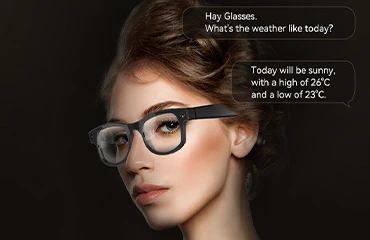
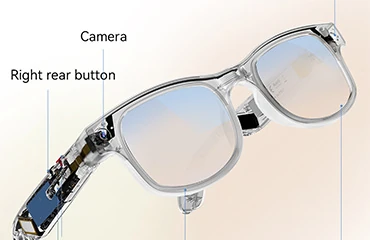
I recently purchased a pair of AI glasses that support real-time speech-to-text conversion (they capture sound via a bone-conduction microphone and display captions on the lenses). I invited Xiao Chen to try them on and held a one-hour team meeting.
Real-world experience:
After Xiao Chen put on the glasses, the system automatically converted the speakers’ words into Chinese subtitles, displaying them at the bottom of the lenses.
At a normal speaking pace, the subtitles had a delay of about 0.5 seconds, maintaining near-real-time synchronization.
When two people spoke simultaneously, the system prioritized the content of the louder speaker and labeled it as “multiple speakers.”
When someone used technical terms (such as “KPI conversion rate”), the system recognized them correctly (with an accuracy rate of about 92%).
After the meeting, Xiao Chen told me in sign language: “This is the first time I’ve fully ‘heard’ and understood the content of a meeting. Before, I could only guess; now I can ‘listen’ with my eyes.”
We conducted a comparative test using a 5-minute recording of a meeting. Chen’s lip-reading accuracy was 37%, while the accuracy of the AI glasses’ captions was 91%. Information retention improved by 2.4 times.
The glasses’ speech recognition engine supports offline mode (no internet connection required), protecting meeting privacy. It can also recognize seven languages and supports real-time translation—if a speaker is speaking English, the lenses can display a Chinese translation. I tested Chinese-to-English translation, which had an accuracy rate of about 85%—sufficient for everyday communication.
A 2024 report by the American Academy of Audiology noted that AR captioning glasses are currently one of the most promising assistive devices for the hearing impaired. Their advantages lie in the fact that they “do not obscure the face or interfere with lip-reading” and can be used in conjunction with traditional hearing aids.
Three months later, the company provided the same glasses to two other colleagues with hearing impairments. Now, there are no more “silent corners” during meetings.
The greatest value of technology is that it enables everyone to participate on an equal footing.
Thank you to Venus Smart Shop for making these AI glasses a “second set of ears” for our colleagues with hearing impairments.
Please log in to your member account first. *



0 Comments